
A Graphical Simulation Of How Social Networks Impact Social Bifurcation
How do people fragment?
There are daily global issues that occur for various factors that affect bondings and connections within societies. An example would be environmental challenges being either supported or neglected by individuals, organizations, and governments. A political movement called Sunrise Movement, for example, stepped in to support the Green New Deal with a mission to reduce the affects of climate change. However, these efforts were hindered as many climate protection rules were removed by the former US president. This led to a great deal of tension between individuals supporting the movement and others taking it lightly. A growing divide — also known as social bifurcation — became an increasingly familiar phenomenon. Here, we focus on the split and apply 3 theoretical simulations to tell the story of polarization.
Simulating innate preference
Our first simulation provokes a case where enforced influence is not a factor. For example, individuals will not try to convince their neighbors to believe in their own ideologies. People will follow what they innately believe in while also being impacted by the beliefs of others surrounding them.
We illustrate this phenomenon by fixating on a small group of people on the topic of climate change. While support largely depends on party affiliation, neither party is overtly trying to change the beliefs of the other. Even with inner beliefs like religion not being forced on others, people are still inclined to match with their surroundings, often adjusting their beliefs to coincide with the local majority.

INPUT: Percentage of party A and party B affiliations on an idea held or disputed among them. Neutrals (people with no affiliations) are included to make the simulation closer to the real world.
OUTPUT: The party with a higher following will increase in support while the party with less followers will decrease in support.
Simulating single-sided action with compact affiliations
In this simulation, supporters will intentionally try to spread their beliefs and encourage others to adopt their ideology. Whether it was for ethical or unethical reasons is beyond this project’s scope, however, we will look into spreading awareness on the importance of preventing climate change.
We start with 3 categories of people: party A, party B, and Neutrals.
Here, we are assuming party A supports climate change prevention and is trying to use their voice to increase their support amongst many people who may not aware of the issue initially. In this simulation, we added connections for party A to ensure their message was heard across a larger audience.
This simulation would result in an increasing the number of individuals believing in party A’s ideology due to their persistent effort to spread awareness.
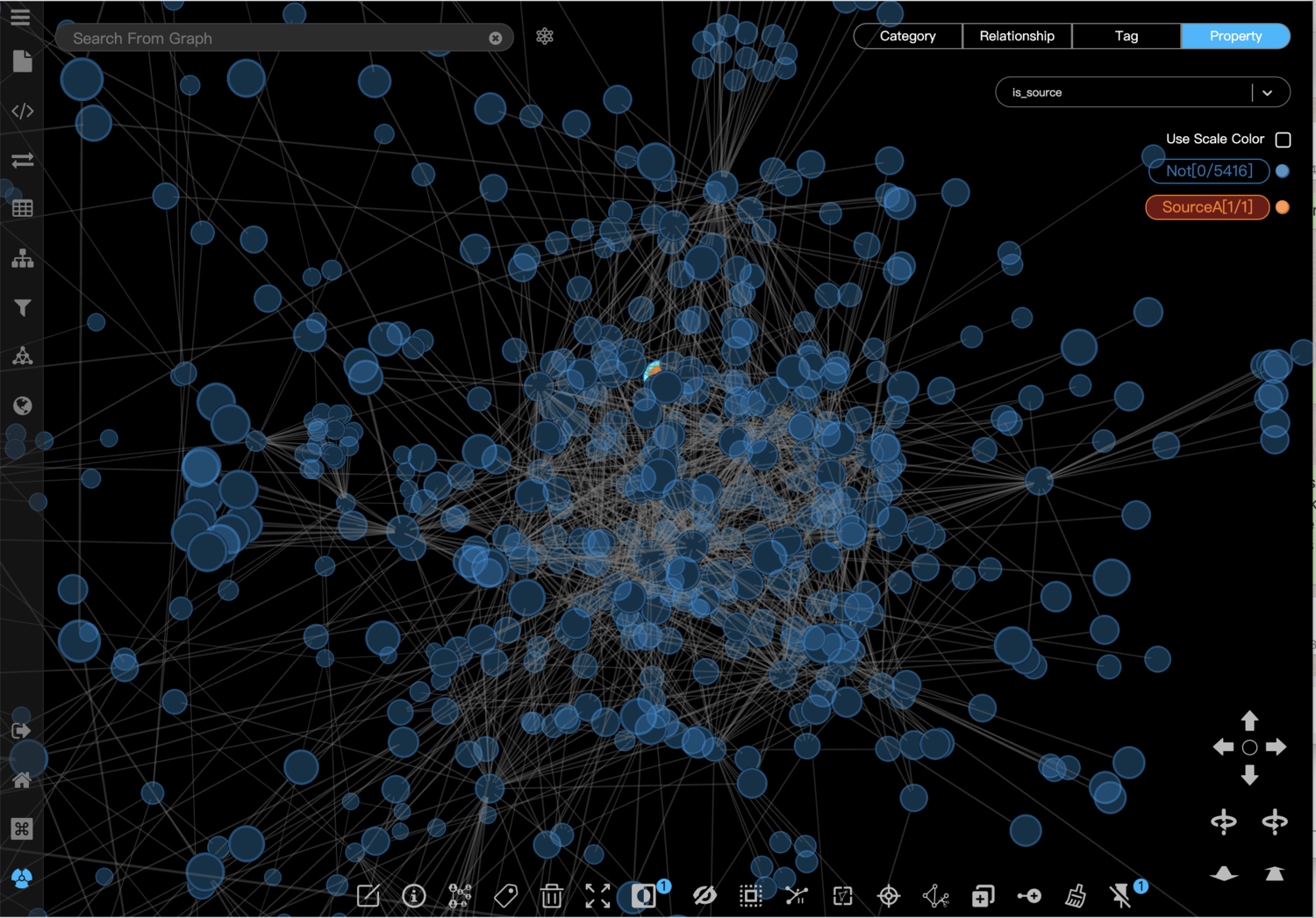
INPUT: In addition to the input mentioned in the first simulation, we add a strong source node to party A that represents where the original message in social media propagated from.
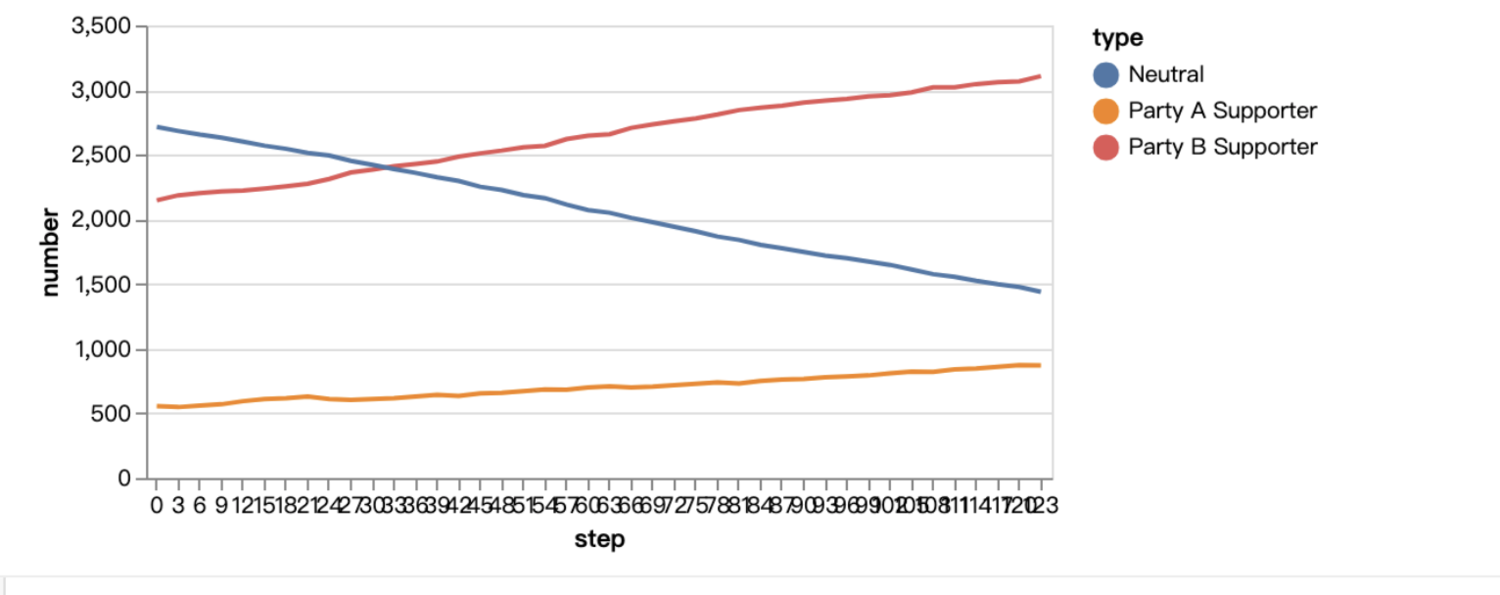
OUTPUT: We ran this simulation on GraphXR Grove to see how Party A’s message got across. We observe an increase of support for Party A with a decline in neutral-standing people over time.
Simulating single-sided action with limited affiliations
The same as the previous model, the party that will take action to spread awareness will be the minority, but we started with a weak source node connected to fewer people. Nonetheless, we still has the same number of groups in the previous model.
In this simulation, let’s assume that party A was the minority group and held the idea that climate change was not real or not as serious as everyone else believed it to be. Although the majority might not believe them, there might be a shift in belief towards party A’s claims. This could be compared to how the previous POTUS removed many of the laws acting on behalf of climate change, an action which led to climate change skepticism. While this led to increased opposition on the topic of climate change, the majority in support of climate change efforts remained strong.
Our simulation shows a small shift towards party A’s ideology of climate change skeptics, while showing those in support of reversing climate change remained with the majority in party B.
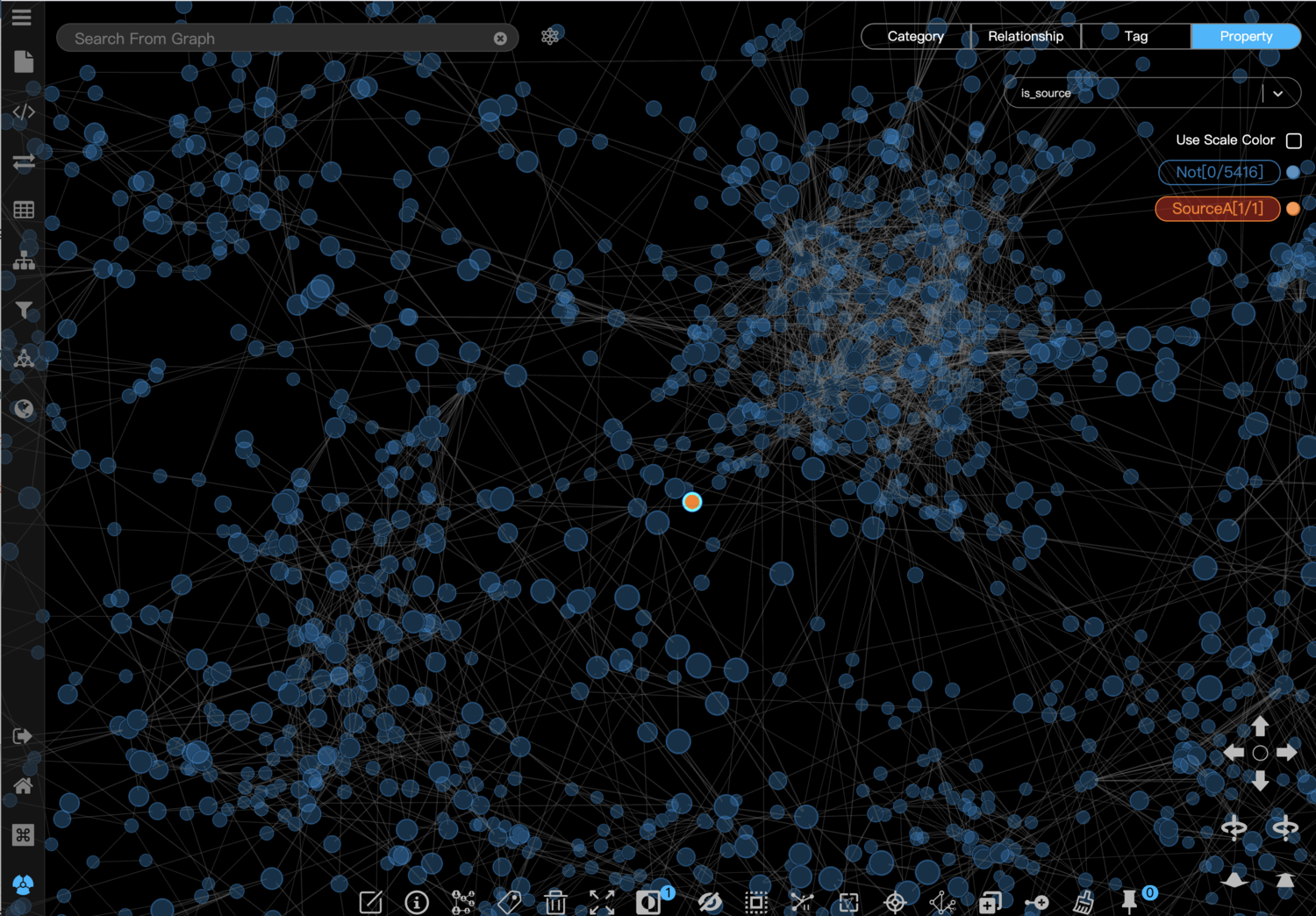
INPUT: The inputs will be the same as the second simulation, but the source node is weaker with fewer connections.
OUTPUT: The party with the largest support (party B) remain strong while party A’s impact on spreading their ideology gradually declines.
Special thanks to USF Teaching Assistant, Aarthi Parthipan, and Kineviz sponsor, Weidong Yang.This research was provided in collaboration with USF and Kineviz. Learn more about the tools used in this blog by contacting our team or simply by signing up for a free GraphXR account and learning how-to graph today!
RESOURCES
Call for the Green New Deal, 3 May 2021, www.callforthegnd.org.
Popovich, Nadja, et al. “The Trump Administration Rolled Back More Than 100 Environmental Rules. Here’s the Full List.” The New York Times, The New York Times, 16 Oct. 2020, www.nytimes.com/interactive/2020/climate/trump-environment-rollbacks-list.html?mtrref=thespark.atlassian.net&gwh=C42DF1E8F1855724E8592DA71EADD25D&gwt=regi&assetType=REGIWALL.
“The Science Behind Why People Follow the Crowd.” Psychology Today, Sussex Publishers, www.psychologytoday.com/us/blog/after-service/201705/the-science-behind-why-people-follow-the-crowd.
Originally published at https://www.kineviz.com on July 7, 2021.